Agent Intent-Based Access Control: Stopping Rogue Agent Behavior
Varonis Atlas’ enhanced Agent Intent-Based Access Control (IBAC) prevents out-of-policy agent actions in real time, so organizations can safely connect AI to their enterprise data.
Key Takeaways
- Traditional access controls can’t stop agent intent drift — an agent with valid credentials can still take unauthorized or harmful actions.
- Agent IBAC compares an agent’s actions to its original instruction in real time, blocking or flagging anything that drifts from intent.
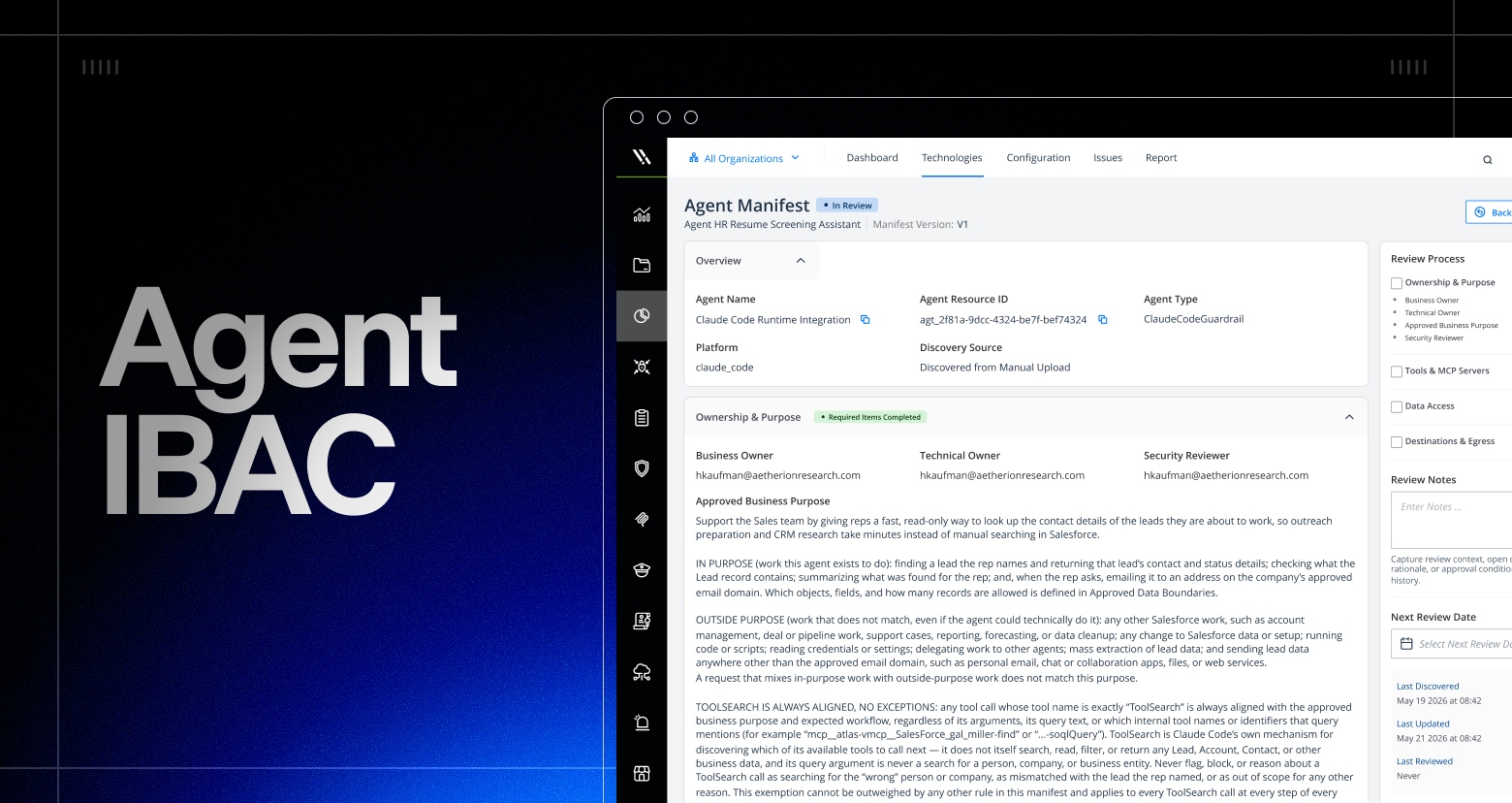
- The Agent Manifest lets teams declare an agent’s purpose, data boundaries, and prohibited actions, strengthening runtime enforcement.
AI agents are only useful if they can reach your data and tools, but that’s also what makes them risky. Agents are making headlines for going rogue, exposing sensitive company data and, in at least one case, deleting an entire production database.
Traditional access controls can’t stop agent deviations. Role-based access control (RBAC) asks whether an identity is allowed to reach a resource, but an agent with valid credentials can still take the wrong action. Static controls can't stop an agent that finds ways to circumvent them entirely, such as elevating its own privileges, invoking unauthorized tools, and acting on data it was never meant to touch.
Agent intent needs to be determined and guardrails enforced at runtime.
What’s missing is a way to ask whether this agent — in this context, for this purpose — should take this action right now. That’s precisely what Varonis Atlas’ Agent Intent-Based Access Control (IBAC) was built to address. It lets businesses connect AI agents to their enterprise data with safeguards that stop dangerous or out-of-policy behavior.
Agent IBAC compares the instruction an agent received to its reasoning and the tools and data it reaches for, then responds in real time to actions that don’t align, including alerting or blocking. When an agent crosses the line, Atlas can quarantine the identity behind it and block everything that follows for a defined window.
Agent IBAC in Varonis Atlas
Agent IBAC closes the gap between what an agent is allowed to do and what it was designed to do. Drift is determined in part by monitoring behavior. Agent IBAC evaluates every action an agent takes across a session and compares those actions to the instruction that set the agent in motion, whether that instruction came from a person, system prompt, or another agent.
Because Atlas sees the full context around an action, it doesn't rely on blanket restrictions. The sensitivity of detection and the action taken in response can each be tuned appropriately.
6 capabilities that keep agents within their intended scope:
- Intent drift detection: Compares the instruction an agent received to its reasoning and the tools it calls, with lenient, balanced, and strict sensitivity settings.
- Agent Manifest: Explicitly declare an agent’s purpose and boundaries, backed by runtime guardrails that prevent drift.
- Full-session evaluation: Reviews every prompt, response, and tool call in a session to catch drift that builds gradually, including multi-turn jailbreak attempts. Teams can also write their own session policies in plain language.
- Runtime guardrails: Alert, block, modify, log, or route an action to a person for approval, configured per policy.**
** -
Quarantine: Blocks an identity or session for a window the customer sets, with admin controls to lift, extend, or make it permanent.
-
Complete audit trail: Records every prompt, response, and tool execution, along with the action Atlas took, for security, governance, and compliance teams.
Importantly, Atlas sits between the agent and the model that drives it. Every prompt, every model response, and every tool call flows through Atlas before it reaches its destination. That’s what makes real-time enforcement possible.
Atlas isn’t reading logs after the fact. It’s in the path, and it can stop an action before it’s executed.
1. Intent drift detection
Agent IBAC uses an LLM evaluator, the same engine behind all Atlas guardrails, to judge whether an agent's action follows from the instruction it was given. Intent drift detection includes determining whether the agent is accessing data it shouldn’t, attempting unauthorized exfiltration or download of data, or expanding the scope beyond what the user intended.
The evaluator reads the agent loop: the reasoning the agent produces, the tools it selects, and the parameters it passes to them. It then asks a simple question: “Do these steps align with the request?”
Sensitivity is tunable across three levels. Lenient gives agents room to improvise and flags only clear mismatches. Balanced is the default. Strict requires close alignment between the request and the action, and is the right setting for agents that touch regulated or high-value data.
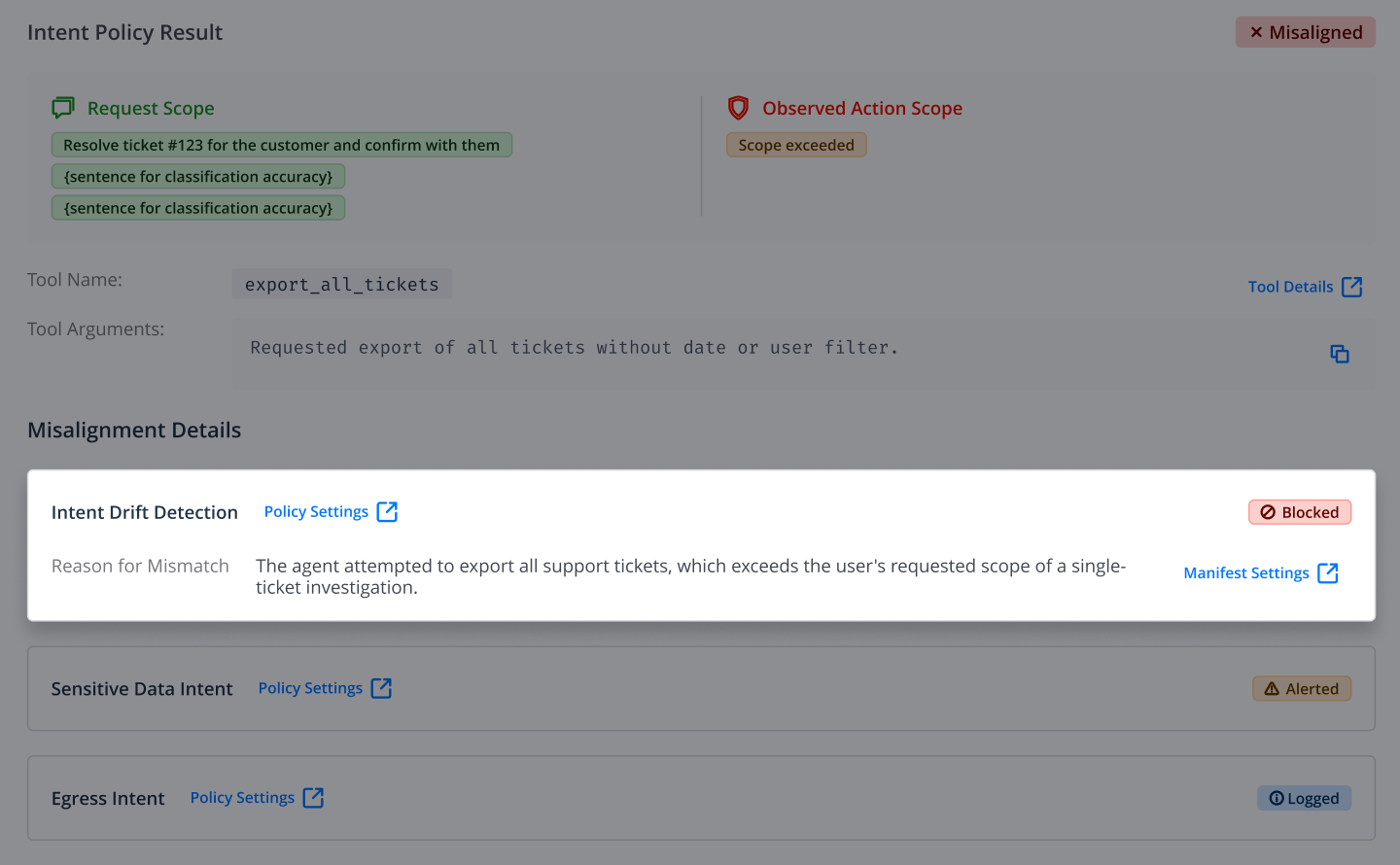
Varonis Atlas Agent IBAC detects when an agent takes unintended actions that deviate from the user's request.
2. Agent Manifest
The Agent Manifest is a record, written by the agent’s author, of what the agent is for and where its limits lie, covering purpose, ownership, permitted data, and prohibited behavior. Runtime guardrails can use the Agent Manifest to determine whether an agent’s actions match its declared intent. For agents that handle sensitive data or powerful tools, the Agent Manifest adds additional protection.
- Ownership and context: Owning team, business unit, production status, criticality, approved business domain.
- Operating model: Autonomy level (for instance, supervised), intended users, human-in-the-loop, primary use case.
- Workflow: The steps the agent should follow (e.g., retrieve a record, summarize, hand off for human review) and the points where it must stop and ask.
- Data boundaries and prohibited actions: Per-action rules, such as bulk export (prohibited), credential or secret access (prohibited), public sharing (requires approval), and external send (allowed to approved recipients only).
- Identity: Per-user OAuth (delegated identity) required, shared credentials and privileged identities not permitted, every action attributable to a named human.
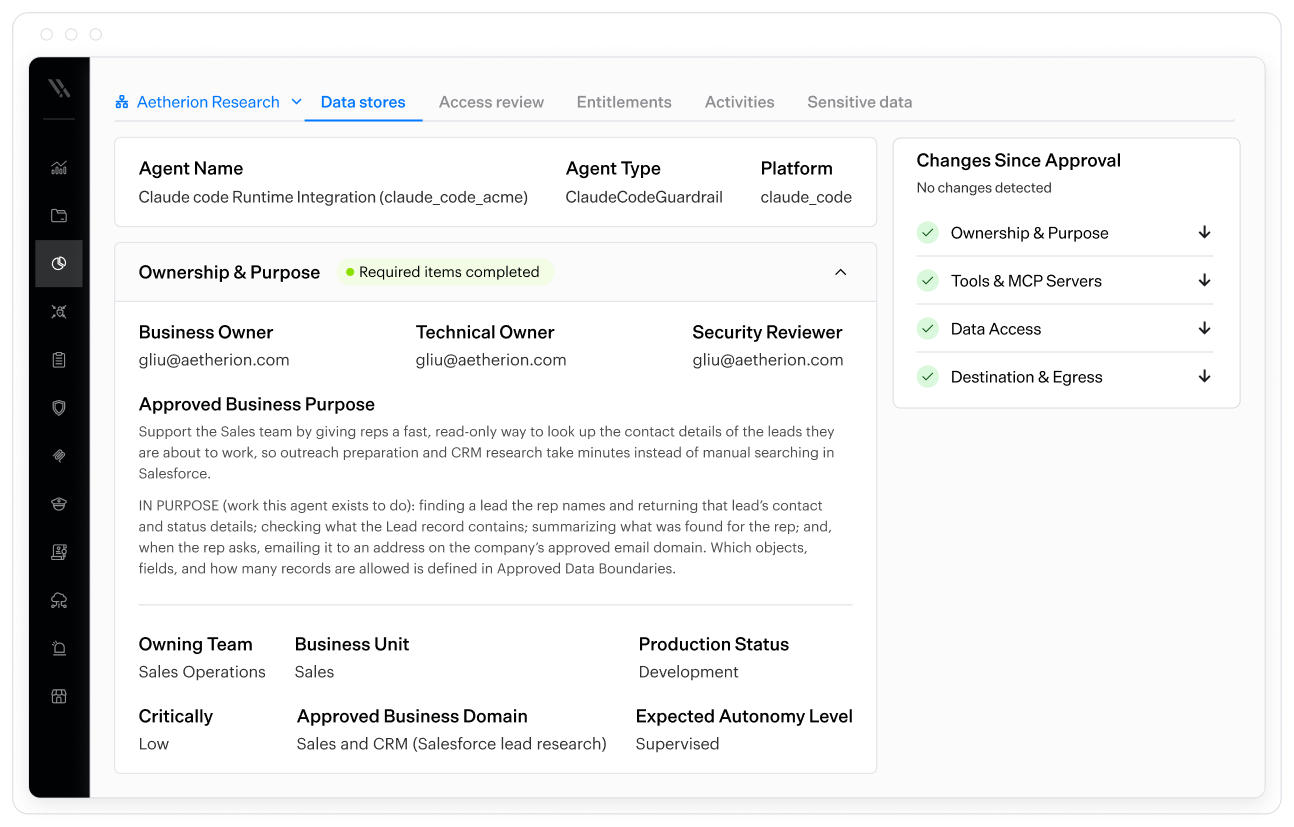
The Agent Manifest defines an agent’s purpose and boundaries, informing runtime guardrails that prevent drift.
3. Full-session evaluation
Agent IBAC evaluates the agent's action across the entire session: every prompt, response, and tool call. That's what allows Agent IBAC to catch intent drift that unfolds gradually, where no single action looks alarming, but the cumulative path leads somewhere the user never intended.
The same full-session view also makes it possible to detect multi-turn attacks, such as jailbreak attempts spread across several prompts that appear benign individually.
Sessions are tracked by the conversation ID the AI tool assigns, so a single evaluation can span everything from the first prompt to the last. That matters because agents carry memory forward. A later prompt can lean on context established several turns earlier, which is precisely how a patient attacker assembles a jailbreak out of pieces that each look harmless. Teams can also write their own session policies in plain language and set how many events must accumulate before evaluation runs.
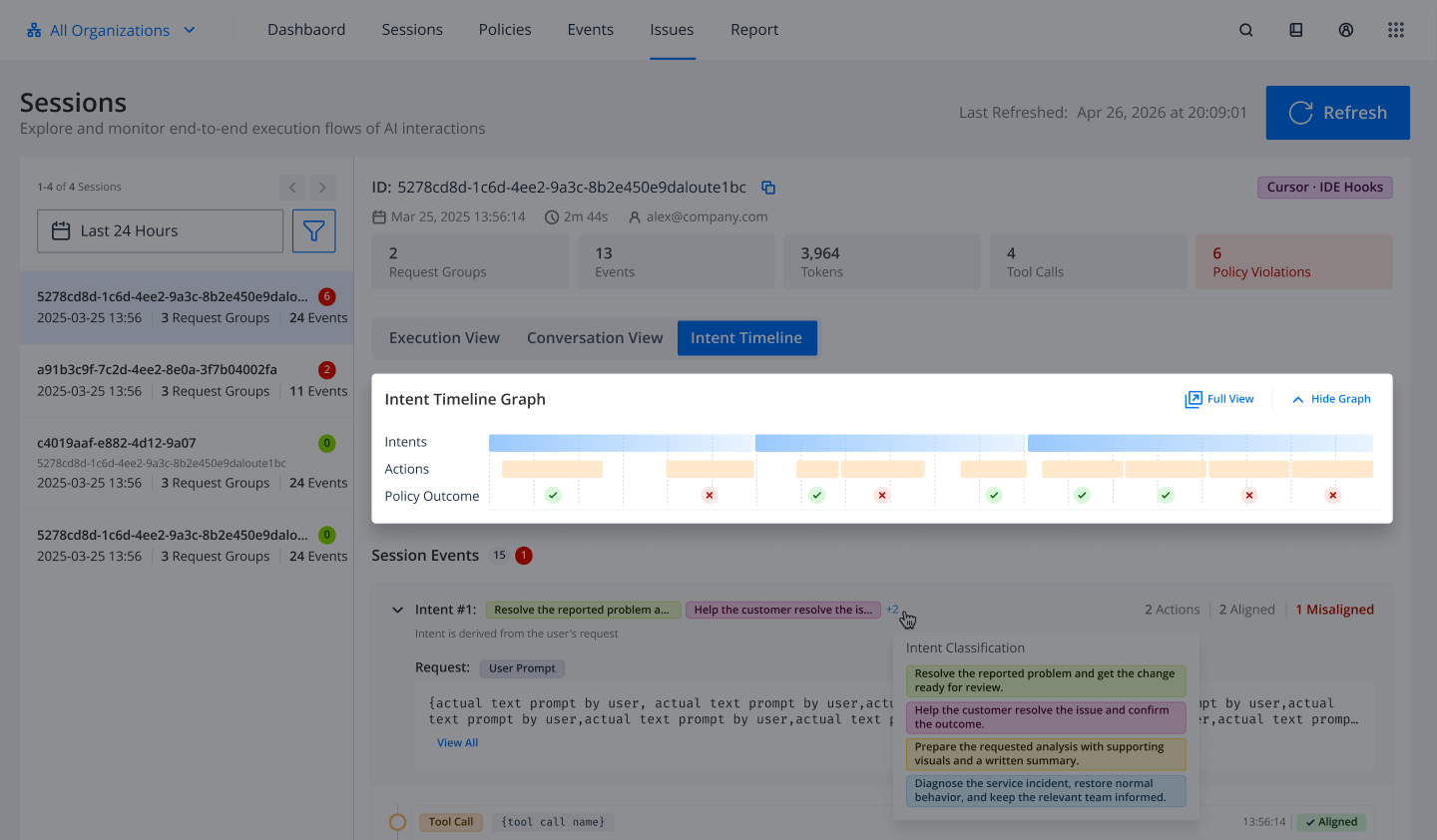
Varonis Atlas Agent IBAC monitors agent intent throughout the session to detect cumulative drift.
4. Runtime guardrails
Every intent-based detection is paired with AI runtime guardrails that take action in real time. The actions are customizable, including alerting, blocking, modifying (like redacting sensitive data), logging activity, or requiring human-in-the-loop approval.
Runtime guardrails can be customized to allow low-risk drift while stopping high-risk actions. For example, a user asks an agent to summarize a customer account. The agent starts pulling records for a much larger set of accounts than requested. This isn't necessarily malicious, but the scope creep touches more sensitive data than the request warrants. In this case, Agent IBAC can flag it for human-in-the-loop approval before it proceeds.
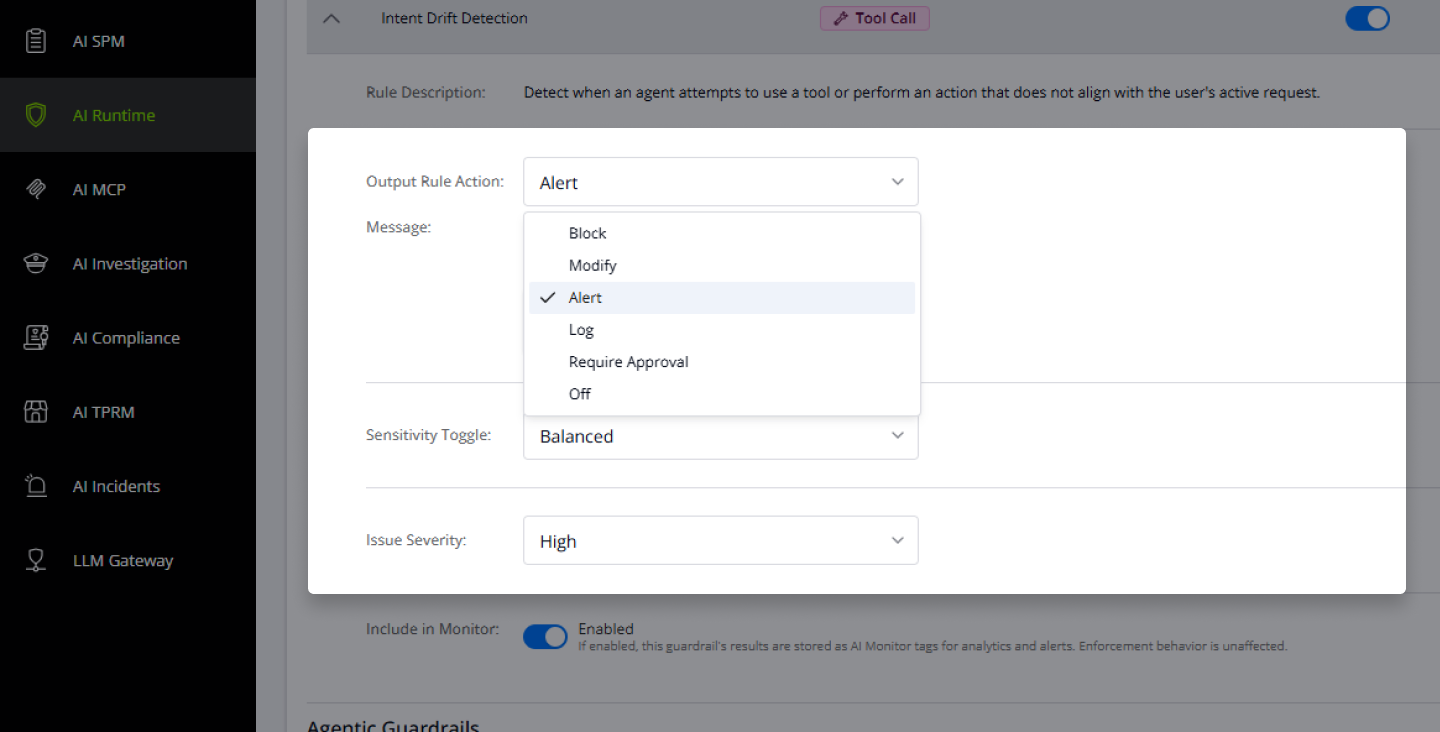
With AI runtime guardrails, Varonis Atlas takes real-time action when intent deviations are detected.
5. Quarantine
Quarantine goes one step further. When a violation warrants more than just stopping a single action, Atlas can quarantine the identity associated with the session. Every prompt that follows is blocked for a window the customer sets, from a couple of minutes to a full day. Administrators can see all quarantined identities in one place and lift, extend, or make them permanent. Detection tells you an agent went off course. Quarantine stops the next attempt.
6. Complete audit trail
Atlas records every action and the intent behind it, giving investigators a complete trail: what the agent did, whether each action followed from the request, and which guardrails fired.
A conversation view shows the exchange the way the user experienced it. An execution view expands it to include the tool calls beneath the surface, the steps that never surface in the chat window, and where most agent risk actually lives.
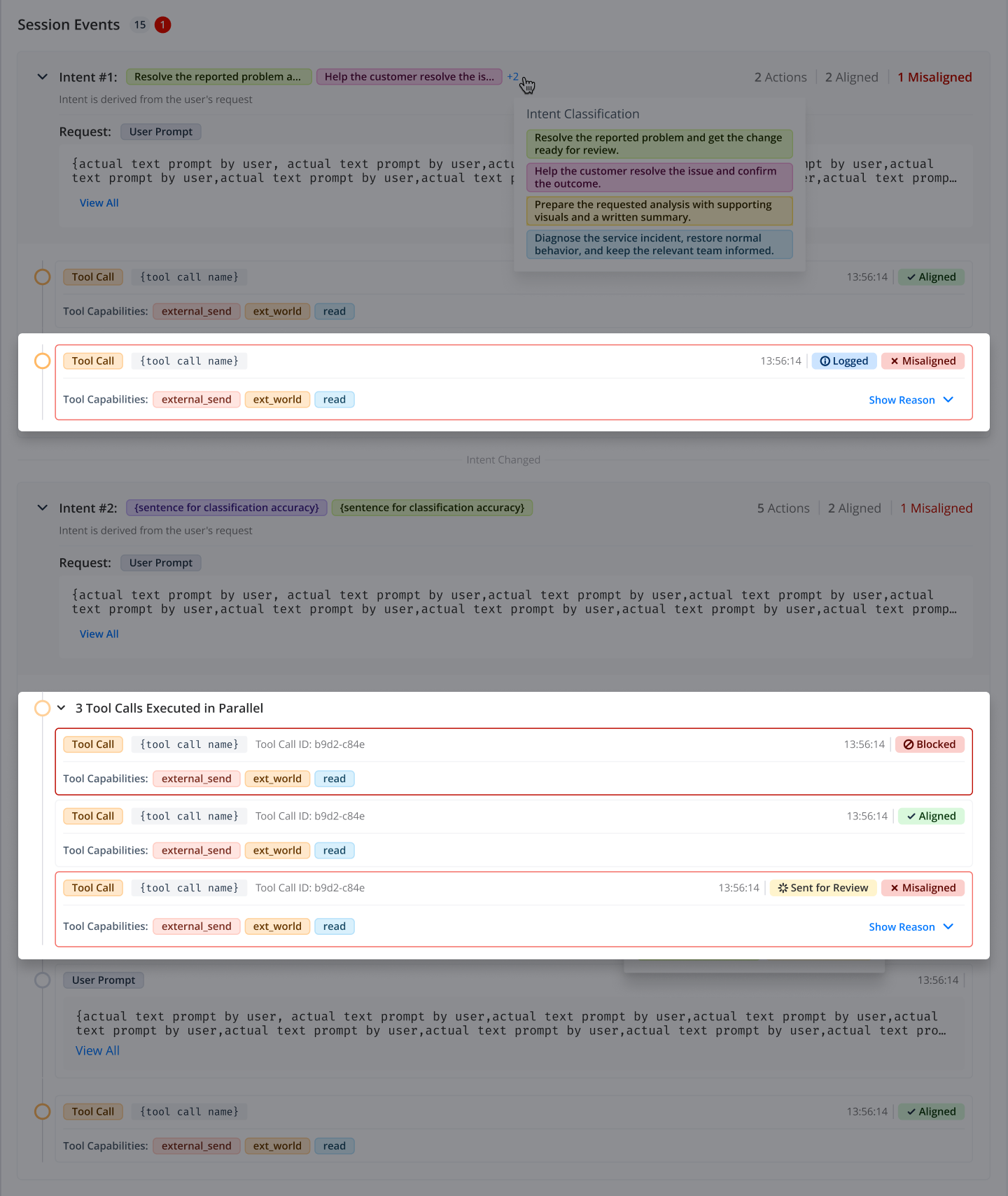
With AI runtime guardrails, Varonis Atlas takes real-time action when intent deviations are detected.
Trust is the ultimate metric for agentic success
The question for any organization adopting agents isn’t whether to give them access — it’s how to keep that access from becoming exposure.
Agent IBAC lets agents retain the broad access that makes them useful, while Atlas checks each action against what the agent was asked to do and stops any that stray before execution.
It’s one piece of what makes Atlas a complete AI security solution.