Featured

Welcoming OpenShell to the CNCF: Open Governance to Secure Agentic AI
Today at KubeCon + CloudNativeCon North America, the Cloud Native Computing Foundation (CNCF) welcomes OpenShell as a Sandbox project. NVIDIA has contributed OpenShell, an open source runtime for securing and governing autonomous AI agents, to the...
November 10, 2026 | Jonathan Bryce (CNCF), Ali Golshan (NVIDIA)
Showing 916 of 2738 posts

Gang scheduling and topology-aware placement for AI training in Kubernetes
Distributed AI training workloads impose complex scheduling requirements that Kubernetes’s built-in scheduler can’t meet. Kubernetes schedules pods individually and independently, but distributed training introduces two requirements that break this model: Pods must land on hardware with...
November 12, 2026 | David Lentz, DataDog

OpenShell on Kubernetes: A guide for platform engineers
What OpenShell is AI agents do more than call APIs. They run shells, install packages, read files, and open network connections. Often they act on text they pulled from the internet a minute earlier. So every...
November 11, 2026 | Jim Bugwadia, Nirmata

Platform engineering needs to become more human…and less
Even my family thinks I’m a little robotic. Logical, linear, sequential, methodical. But hey, I’m an engineer, and that’s part of what makes me good at my job. If I were operating on the same volatile...
November 11, 2026 | Alejandro Chirinos, Control Plane
One flag, many guardrails: Making a platform safe enough to delegate
This post draws on a talk co-presented with Julien Semaan of Kubex at KubeCon + CloudNativeCon Europe 2026; GitOps Gone Wild: Hardening Delivery Pipelines for the AI Era Most platform teams are having meetings to discuss...
November 10, 2026 | Corey McGalliard, Akamai
Run Linux applications in hypervisor-isolated micro-VMs with Hyperlight
More and more cloud native systems run code nobody on the team wrote: the Python an AI agent generated a second ago, or a plugin a customer just uploaded. Each of them needs a boundary between...
November 9, 2026 | Danilo Chiarlone, Microsoft
Faster LLM inference startup: What you need to know
Adding an inference replica creates capacity only after the new instance can serve requests. Between starting a process and generating a response, an LLM server may need to load weights, initialize GPU resources, compile kernels, capture...
November 6, 2026 | Baofa Fan, DaoCloud
OpenTelemetry-powered distributed tracing and Kubernetes events in OpenChoreo
Getting code from a developer’s editor into production means building it, testing it, deploying it, and then understanding how it behaves once it’s running. Internal Developer Platforms (IDPs) promise a “golden path” through all of that,...
October 27, 2026 | Nilushan Costa and Akila Induranga WSO2
Filtering and reducing AI agent telemetry with the OpenTelemetry Collector
Turn on an AI coding agent’s telemetry and it throws a wall of text at you. It’s expensive to store and what’s worse, you can’t make sense of it. It’s all OpenTelemetry native, though. So you...
October 22, 2026 | Adnan Rahic, Bindplane by Dynatrace
Distributed tracing for CI pipelines without touching a single workflow file
You’ve probably felt this one: GitHub Actions usage creeps up across your org, and your actual visibility into it doesn’t keep pace. Which workflows are slow? Which are flaky? How long are jobs sitting queued for...
October 21, 2026 | George Sims, Proton.me

Before you evaluate an AI SRE, give your existing agent context
If you’re evaluating AI SRE products, you probably own most of one already. The coding agent your engineers use, whether that’s Claude Code, Codex or Cursor, can already investigate a Kubernetes cluster. What it usually lacks...
October 21, 2026 | Roy Libman, CPO, Radar (Skyhook.io)

How AI workloads are reshaping Kubernetes autoscaling
Kubernetes has quietly run much of the world’s containerized software on a division of labor between two control loops that rarely had to talk to each other. The scheduler places each pod on a node that...
October 19, 2026 | Sajjan Gundapuneedi and Neelendra Bhandari, AWS

Deploying, maintaining, and migrating production n8n on EKS
n8n is easy to try and harder to run under production traffic. A single container with SQLite works great for a quick demo. Production is a different story entirely. You need workers, webhook processors, PostgreSQL, Redis,...
October 16, 2026 | Husne Ozmen, Fairwinds

Extending Kubernetes policy enforcement to runtime security for AI workloads
Nirmata created Kyverno and donated it to the CNCF in 2020. Kyverno is now a graduated CNCF project and is widely used for enforcing and automating configuration security and best practices. However, admission control answers one...
October 15, 2026 | Nirmata
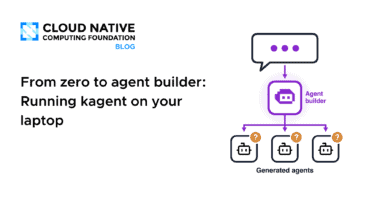
From zero to agent builder: Running kagent on your laptop
If you have seen a demo of a no-code agent builder, you know the moment. Someone types one sentence, waits a minute, and there it is: a new agent, running, with tools. It is impressive. For...
October 12, 2026 | Antonio Berben(Solo.io) and Felipe Vicens(Telefónica)
Who owns NIS2 and DORA on a Kubernetes platform team
There is a meeting that repeats across a lot of European engineering organizations right now. Someone from legal or risk brings a NIS2 control, a DORA article, or a “can we evidence this” request into the...
October 9, 2026 | Matteo Bisi, Reevo

Every SaaS company has the same uncomfortable question after a major incident: who noticed first, the monitoring or the customers? For a long time our honest answer was “it depends”. This post describes how a small...
September 30, 2026 | Deepak Biswas, Senior Engineering Manager, Central Monitoring and Disaster Recovery, Atlassian

The case for a cloud native agent harness
Coding agents became useful when they stopped being a chat box. Four things changed the shape of the problem: capable tools, a shared repository and filesystem, subagents, and skills that capture what the system learned from...
September 28, 2026 | Craig McLuckie, Stacklok
OpenTelemetry everywhere: Migrating a metrics platform at scale
Why we did this at all For most of the last decade our metrics pipeline ran on gostatsd, the open-source StatsD implementation we maintain. It primarily did two jobs: as sidecar on every host and the...
September 17, 2026 | Iris Grace Endozo, Farzad Vazirnia and Albert Kerr, Atlassian

Building a reliable cloud native foundation for distributed AI training
AI workloads are changing what platform teams need from infrastructure. Provisioning GPUs and standing up a cluster no longer makes a platform “AI-ready.” Once training spans more than one node, the bottlenecks show up in places...
September 11, 2026 | Abhi Kulkarni and Shishir Jindal, Atlassian
How cloud native goes AI native
“A sales guy writing code” used to be the lead-up to a joke. But now no one’s laughing. Designers used to sit meekly waiting for the high priests of code to make their designs real. Now...
September 9, 2026 | Doron Grinstein, CEO of Control Plane